Part 1: Introduction
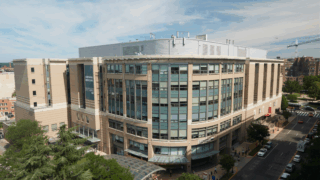
Located in Washington, D.C., George Washington University School of Medicine is the first medical school in the U.S. capital. GW School of Medicine is known for its health and biomedical sciences. Because of its location in Washington, D.C., the school of medicine offers unique opportunities in government areas and non-profit organizations.
GW School of Medicine partners with the GW Hospital, GW Medical Faculty Associates, Children’s National Health System, Washington DC VA Medical Center, and more.
George Washington University School of Medicine has excellent opportunities for prospective students. Today, we’ll give you a virtual “tour” of what the university has to offer: its programs, cost of attendance, admissions requirements, secondary essays (with samples!) and interview information. By the time you’re finished reading this guide, you should have a pretty good idea of whether you want to apply to George Washington University School of Medicine.
We’ve split this guide up into five parts, so you can easily navigate to the sections that matter most to you:
- Part 2: Programs at GW School of Medicine
- Part 3: Test Scores, Grades and Other Requirements
- Part 4: Secondary Essay Questions with Samples Essays
- Part 5: Interview Day: What to Expect
Let’s dive in!
Part 2: Programs Offered at George Washington University School of Medicine
George Washington University School of Medicine offers the following programs:
- MD Program
- MD/Master of Public Health Program
- Physician Assistant Studies
- Biomedical Laboratory Sciences
- Ph.D. in Cancer Biology
- Ph.D. in Genomics and Bioinformatics
- Ph.D. in Microbiology and Immunology
- Ph.D. in Neuroscience
- Ph.D. in Pharmacology and Physiology
- Ph.D. in Translational Health Sciences
- International Medicine Programs
In this article, our main focus will be on the MD program. We’ve linked the other programs to their respective pages on the GW School of Medicine website, so you can navigate to what interests you. We’re including brief descriptions of each program below, as well. Will the information provided throughout the rest of this guide be useful if you’re interested in a program other than the MD program? Yes. While some details might be different, the application process is much the same, and the information provided in the secondary essays section will benefit every applicant/prospective student.
Inside the MD Program
Like many MD programs, George Washington University School of Medicine has three phases, but its phases are unique.
- Fundamentals of Medicine
- Fundamentals of Clinical Practice
- Transition to Advanced Clinical Practice
Fundamentals of Medicine
This first stage of the program involves an introductory course and classes that expand beyond the bachelor’s level of science courses. Subjects include Anatomy (both microscopic and gross), biochemistry/genetics, physiology, pharmacology, pathology and microbiology. Prevalent themes throughout these courses include human behavior and development, clinical skills and reasoning, public health and health policy, professional development and diversity. Courses are as follows.
- Student Orientation
- Foundations of Medicine
- Immunology/Hematology/Inflammation/Infectious Disease
- Cardiology/Pulmonary/Renal
- Gastrointestinal/Liver
- Musculoskeletal/Spinal
- Brain & Behavior
- Endocrinology/Reproduction
- Practice of Medicine 1, 2 and 3
- Fundamentals of Patients, Populations and Systems
- Applying Principles of Patients, Populations and Systems
- Patients in Health Systems
Fundamentals of Clinical Practices
This phase takes things to a new level with students entering clerkship territory. They are also allowed to take elective courses, which is a key part of determining what their specialty will be. Clerkships and courses are as follows:
- Foundations of Clinical Practice
- Internal Medicine
- Surgery
- Pediatrics
- Obstetrics/Gynecology
- Primary Care
- Psychiatry
- Electives
Transition to Advanced Clinical Practice
This third and final phase of the MD program puts more pressure on students who are preparing to enter the field as Doctors of Medicine. The course load is intense to provide upcoming graduates with the most amount of preparation. Courses are as follows.
- Acting Internship
- Emergency Medicine
- Capstone Course
- Electives
- Neurology
- Anesthesiology
MD/Master of Public Health
George Washington University School of Medicine and the Milken Institute School of Public Health come together to bring this program to students. This program is designed to be completed in five years, and students have the option to take the Master of Public Health courses through the Milken Institute at any point after their first, third or fourth years at GW School of Medicine. Some courses can be taken online, while other courses must be taken at the Milken Institute campus. Go here for more information.
Physician Assistant Studies
Physician Assistants are needed throughout the country, and George Washington University School of Medicine provides an excellent curriculum to introduce new PAs into the field. PAs are allowed to practice medicine under the supervision of a licensed Doctor of Medicine or Doctor of Osteopathic Medicine. Their training is shorter. The lack of extended experience is what requires them to be supervised.
GW School of Medicine provides the following avenues for prospective PA students:
- Physician Assistant
- Physician Assistant/Master of Public Health
The curriculum for PA students is as follows:
- Internal medicine
- Surgery
- Emergency medicine
- Pediatrics
- Obstetrics and Gynecology
- Psychiatry
- Primary (Ambulatory) Care Medicine
The PA/Master of Public Health track offers the following opportunities to students. They are linked to their respective pages on the George Washington University School of Medicine website.
- Community-Oriented Primary Care
- Health Policy
- Epidemiology
- Environmental Health Science and Policy
- Global Environmental Health
Biomedical Laboratory Sciences
This degree offers a wide range of opportunities for pre-medicine students who are interested in laboratory science.
Clinical Research and Leadership
As the course name suggests, this is primarily meant for students who want to increase their knowledge and gain leadership experience.
Health, Human Function and Rehabilitation
This program is designed to help injured people rehabilitate and to help them and their families adjust to any permanent changes in routine.
Please note that these degrees will not award you with an MD degree. They are complementary courses that will add to your knowledge as a doctor. Additionally, these degrees can be taken by themselves for students who want to work in these fields, but who don’t want to become Doctors of Medicine.
Ph.D. Programs
The Ph.D. programs are part of the Institute for Biomedical Sciences. While these degrees will provide you with a wealth of knowledge on topics varying from cancer biology to neuroscience, they are not dual-degree MD/Ph.D. programs, and will therefore not graduate you as a Doctor of Medicine with a Ph.D. Instead, an MD would need to be earned separately, with your Ph.D. as a separate degree.
Cost of Attendance
Based on what George Washington University School of Medicine has to offer, it’s not surprising if you’re ready to turn in your application right now. The question going through your head is probably, “but how much does it cost? Can I afford to attend GW School of Medicine?”
For the 2026–2027 year, tuition runs from $75,551 to $76,738 depending on what year you’re in, with Years 3 and 4 costing more than Years 1 and 2. University fees add $260 to $790 on top. GW School of Medicine publishes a full cost of attendance chart for your budgeting purposes.
- Year 1: $112,556 total
- Year 2: $119,608 total
- Year 3: $127,410 total
- Year 4: $124,705 total
These bullets include all related expenses, such as housing, food and transportation. The total amount you’ll need to pay might be less or more, depending on how much you spend on personal needs. Part of the reason why Years 3 and 4 are more expensive is because of the fees you must pay for residency applications and interviews.
George Washington University School of Medicine gets expensive, but the good news is that they offer financial aid to students who need it. So, don’t eliminate the possibility of attending school at GW School of Medicine until you’ve considered all your options. They rank among the best schools in the country, so they’re well worth your time.
Part 3: Class Stats and Requirements for Getting In
Class Statistics
For the Class of 2020, here are the statistics that George Washington University School of Medicine proudly published on their website.
- Over half the students were female.
- Ages ranged from 19 to 40.
- New students came from 30 different states and countries like China, Saudi Arabia and Canada.
- A wide diversity in ethnic backgrounds: African, African-American, Colombian, Asian Indian, Cuban, Burmese, Filipino, Pakistani, Salvadoran, Puerto Rican, Senegalese, Venezuelan and Vietnamese
- Average 515 MCAT score
- Average 3.88 overall GPA
- Students from over 87 colleges
- Nearly 70% of students have bachelor’s degrees in science majors.
- Popular majors included: Biological Sciences, Psychology, Public Health
Required Courses
- Biology
- Chemistry
- Physics
- Lab experience
- Stats/Biostats/Probability/Math
- English
- Social/Behavioral Science
George Washington University School of Medicine doesn’t list required scores for these classes, but most medical schools accept a C or higher for transfer grades. Courses in which you’ve earned a C- or below oftentimes need to be retaken.
GW School of Medicine also expects students to show strong skills in communication, observation, motor function and emotional and intellectual abilities.
GW School of Medicine requires an MCAT score regardless of version, but it must be recent: for the 2027 cycle, scores must be from January 2023 through August 31, 2026. GW also treats a total below 505, or any subscore of 123 or below, as non-competitive, and a cumulative GPA below 3.25 as non-competitive.
GW also requires the AAMC PREview Professional Readiness Exam, which must be completed between January 2023 and August 2026 for the 2027 cycle. This is a separate requirement from the MCAT and is easy to overlook, if you don’t sit PREview, your application is not eligible for review.
For transfer grades, only classes taken at a college campus will be considered. Online coursework or courses taken at a university outside the United States are not eligible for transfer credits.
Primary and Secondary Applications
George Washington University School of Medicine participates in the American Medical College Application Servicesystem. Commonly referred to as AMCAS, this is like submitting your resume to every major company in your area. Your transcripts, work and activities and personal medical statement are all part of the AMCAS application, and every school you apply to will receive your application. This is known as your primary application.
Here are the requirements for your primary application:
- Complete the entire application, and sign it.
- Obtain a Pre-Health or Pre-Medical Committee Letter or three individual letters of recommendation if you cannot obtain a committee letter.
- Pay a $130 application fee.
Your secondary application is the one you’ll send directly to George Washington University School of Medicine with essays that are tailored to the school. You’ll fill out a secondary application for each medical school to which you apply.
George Washington University School of Medicine employs a rolling admissions system. This means that they review applications as they receive them. Even if the application deadline hasn’t passed, the incoming class can fill up quickly. Once it’s full, you’ll have to wait for the next incoming class to be considered. Because of this, it’s very important to submit your application as soon as possible.
Part 4: Application Essays with Samples
GW’s secondary questions for the 2026–2027 cycle. GW asks six questions and the character limits are tight, so every sentence has to earn its place.
Please provide the Admissions Committee with a brief summary of your activities, academics, employment, or other occupations to account for full-time activity of roughly 30 to 40 hours a week from the point of application through matriculation in 2027. (750 characters)
This is an accounting question, not an essay. List what you will actually be doing and for roughly how many hours. Gaps are fine if you explain them. Vagueness is what causes problems.
The MD Program includes substantial content in Clinical Public Health to prepare GW graduates for an expanded scope of practice. What are your specific interests and experiences related to that aspect of the MD Program? (350 characters)
350 characters is roughly two sentences. Name one concrete interest inside population health, health systems science, health policy or community health, and one experience that produced it. Nothing else fits.
Sample answer
I mapped bus routes against dialysis center locations for a county health department and found four census tracts with no transit access within an hour. I want to keep doing that kind of analysis alongside clinical training rather than after it.
Why it works: At 350 characters there is room for exactly one specific thing and one forward-looking sentence. This gives both and wastes no words on framing.
What makes you a unique individual? What challenges have you faced? What have you learned from your experiences? (750 characters)
Three questions, one small box. Choose a single thread that answers all three rather than addressing them in turn.
Sample answer
I was a competitive oboist before I was a pre-med, which meant a decade of being corrected in public without taking it personally. That turned out to be the most transferable skill I have. In my first month as a medical scribe I misrecorded a medication list and was told so bluntly in front of the team. I fixed it, built a checklist, and stopped making that error. Feedback is not something I have to survive. It is the fastest thing available to me.
Why it works: It answers all three questions with one thread, uses an unexpected background without treating it as a gimmick, and lands on a claim about the writer that a committee can actually use.
What is your specific interest in the MD Program at GW? What opportunities would you take advantage of as a student here?
Name things that exist only at GW. Washington DC is the obvious lever, given the policy and public health access, but say what you would do with it rather than that you find it exciting.
Have you previously interacted directly with the MD Admissions Office through events, tours, fairs, webinars, or interviews? If yes, please explain.
Factual. Answer accurately and briefly.
Remember that GW’s interviews are blind, so anything you want discussed should be in these answers. Prompts can change mid-cycle and schools sometimes add questions after the application opens, so always write to the exact wording in your own secondary portal rather than to any published list.
Part 5: Interview Day at George Washington University School of Medicine: What to Expect
Congratulations if you’ve scored an interview with George Washington University School of Medicine! This is an accomplishment of which you should be very proud.
GW interviews virtually until further notice. Each interviewee has a single interview with a faculty member lasting approximately 25 minutes, and the Admissions Office offers roughly 700 interviews a year. The season runs from late August through March, with the first invitations going out in mid-August.
One detail matters more than any other, and it changes how you should prepare: GW’s interviews are blind. Your interviewer has not read your file beforehand, and you are not told who they are in advance. That means nothing in your application is assumed knowledge, if an experience matters to your candidacy, you have to bring it into the conversation yourself rather than expecting to be asked about it. Applicants who prepare to elaborate on a file the interviewer has already read tend to leave their strongest material unsaid.
Practice giving a clear, self-contained account of who you are and why medicine, without leaning on the reader having your CV in front of them. And note the decision rules: GW communicates outcomes on a rolling basis, but under AAMC traffic rules no offer of acceptance can be made before 15 October. The Committee on Admissions does not provide feedback or counseling, and decisions are final with no appeals.
You’ll have two interviews at GW School of Medicine. Each interview will last for 25 minutes. One will be with a member of the admissions committee, and the other interview will be with a current student. Neither of them will have access to your file, so the interview will be blind for both of you. This helps reduce bias by allowing the interviewer to get to know you without any preconceived notions.
George Washington University School of Medicine asks prospective students to respect the wait time for the interview process. Please do not ask for the contact information of any of your interviewers. You will only be provided with their names. Please don’t call the admissions office to find out the status of your application, as this information is not released over the phone.
Everyone will work hard to get your application decision to you as quickly as possible. Remember, GW School of Medicine uses the rolling admissions system, so the sooner you apply, the sooner you’ll know if you got in.
International Medical Aid is Here to Help.
Applying to medical school is a big deal. It’s a long process that takes focus and determination. That’s why International Medical Aid is here to help. If you’re looking for experiences to boost your volunteer hours, consider going on a trip with us to underserved populations in South America, East Africa or the Caribbean. We have opportunities for every field that might pique your interest.
If you find that you need help with your primary or secondary applications, we’re here for that, too. Our medical school experts will review your primary and/or secondary applications and your essay responses. We’ll also practice interviewing with you. The more you practice, the more prepared you’ll be.
Finally, keep an eye on our blog here at International Medical Aid. We offer definitive guides for different medical schools and osteopathic medicine programs. Just like with this guide, each one provides information on the programs provided, how to apply, tips and samples for essays and what to expect for your interview day.
- Georgetown University School of Medicine
- Yale School of Medicine
- Perelman School of Medicine
- UCLA Medical School
- NYU Medical School
- Washington University School of Medicine
- Johns Hopkins School of Medicine
- Brown Medical School
We wish you the very best of luck as you apply to medical school! Please contact us if you have any questions or if we can help you with anything. International Medical Aid is here to help you on your road to becoming a doctor.
Exploring Other Schools
GW is one of several medical schools in Washington DC and the surrounding region. These guides cover the other programs in the area, including the osteopathic and military options that applicants often overlook:
- Georgetown University Medical School
- Howard University College of Medicine
- University of Maryland School of Medicine
- Johns Hopkins University School of Medicine
- Eastern Virginia Medical School (EVMS)
- Virginia Commonwealth University School of Medicine
- Virginia Tech Carilion School of Medicine
- Edward Via College of Osteopathic Medicine (VCOM)
- Uniformed Services University of the Health Sciences (USUHS)
- University of Virginia School of Medicine